Veylor: A New Zcash Wallet with a Shielded Atomic Bridge
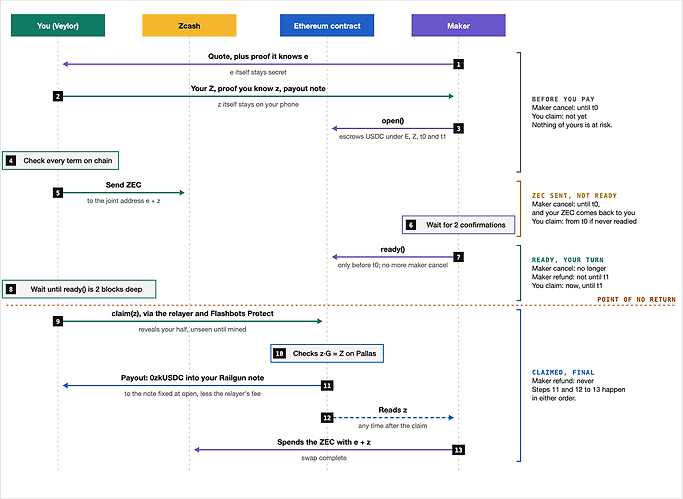
Both the wallet and the bridge are open source and run on mainnet today in a capped beta. So how does this it work? The Bridge The bridge works similarly to an HTLC, where it uses Ethereum’s programmability to escrow the USDC, while the ZEC is held under a spending key that is split between two parties. The contract on Ethereum implements the Pallas elliptic curve and takes advantage of two properties: Given a public point ( E = e·G ) you cannot recover the secret ( e ) used to generate it. The public key of the sum of two secrets is the sum of their public keys: E + Z is the public key of e + z . So both sides can derive the joint ZEC address from E and Z , without anybody holding its full spending key. The flow: The user and the bridge agree on a quote and exchange the public keys of their secrets, each with a proof that they know the secret. The user also sends the bridge the Railgun note the 0zkUSDC must be paid to. The bridge then locks the USDC in the es
Share this story
Skip to swapping
Start a swapRepublished from public RSS feeds for on-site reading, information only; not investment advice. Not affiliated with VeilSwap.